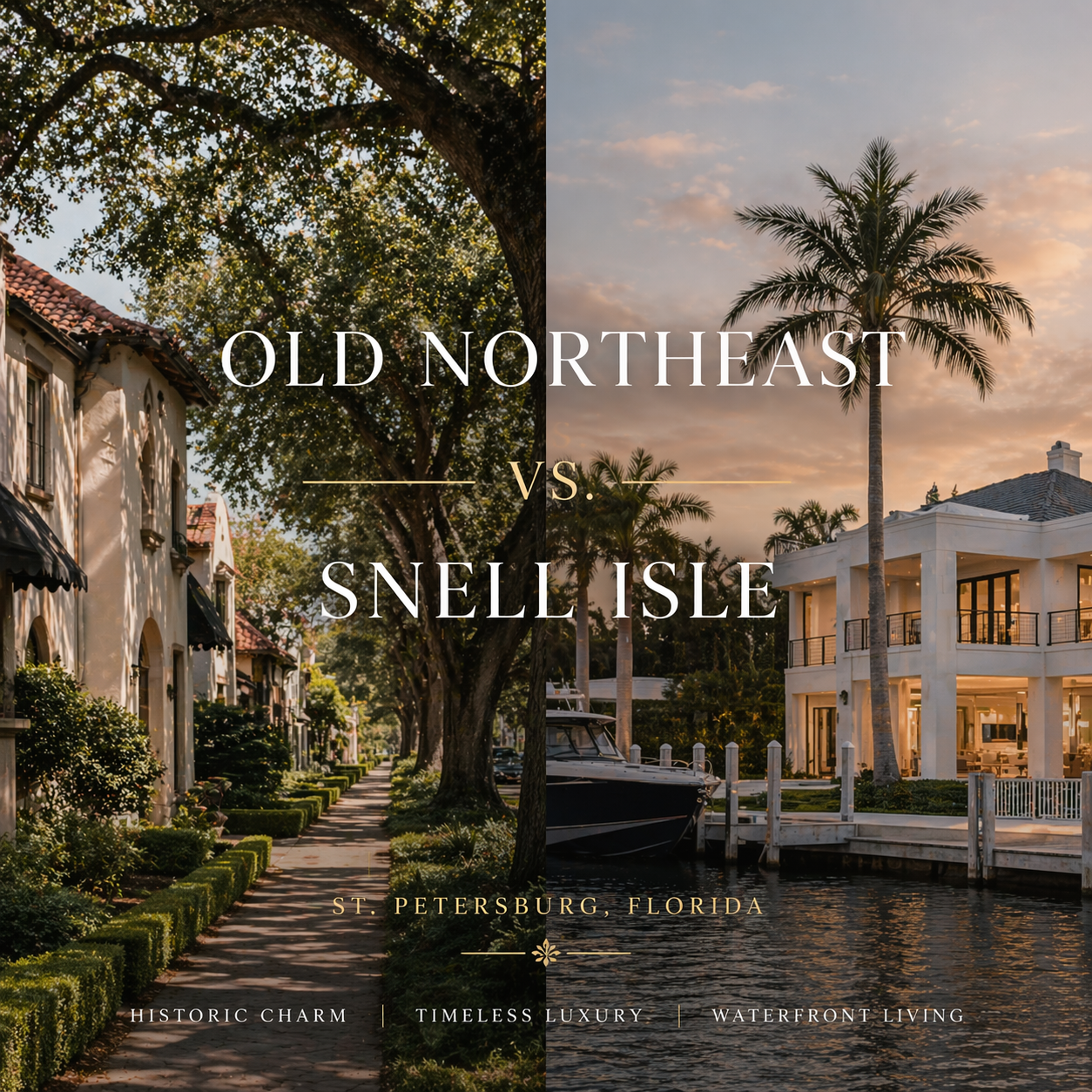
Old Northeast vs. Snell Isle: Which St. Pete Neighborhood Holds Its Value Better?
By Liane Jamason | Corcoran Dwellings | April 2026
Let me save you the Google rabbit hole: this is the question I get from every serious buyer comparing these two neighborhoods, and from every seller who wants to know whether to stay put or cash out. Old Northeast vs Snell Isle real estate is a hot topic. Brick streets or bayfront estates? Historic charm or waterfront exclusivity? Old Northeast vs Snell Isle real estate is a crucial comparison for buyers.
Both neighborhoods are genuinely great. Both command prices that would make the rest of St. Pete blush. But they are not the same, they do not perform the same, and if you’re making a decision based on long-term value — whether you’re buying, selling, or just trying to figure out what your house is actually worth — the differences matter more than the similarities.
When it comes to Old Northeast vs Snell Isle real estate, both neighborhoods present unique opportunities for homeowners.
Understanding Old Northeast vs Snell Isle real estate can greatly influence your buying decision. Buyers often wonder which neighborhood offers better long-term value when contemplating their investments.
So let’s actually talk about it.
First, the Quick Snapshot
Old Northeast is one of St. Pete’s most celebrated historic neighborhoods — 2,975 historic homes and buildings, brick-lined streets, architecture ranging from Victorian to Spanish Revival to Craftsman Bungalow, and a walkability to downtown that newer neighborhoods would kill for. It sits between Tampa Bay and Coffee Pot Bayou on the east, 4th Street on the west, 5th Avenue NE on the south, and 30th Avenue NE on the north. It’s a neighborhood with personality, and buyers feel that the second they walk in.
Snell Isle is something else entirely. It’s a private island community — literally, connected to the mainland by bridges — with waterfront estates, the Vinoy Golf Club, the St. Petersburg Yacht Club, and a median price point that tells you exactly who lives there. Homes routinely trade in the $2M–$10M+ range. It’s less of a neighborhood and more of a destination.
The Numbers (Because That’s What You’re Here For)
Here’s where it gets interesting.
In late 2025, Historic Old Northeast homes were selling at a median price of around $857K — which is a remarkably stable figure considering what the broader St. Pete market has been doing. Homes were averaging about 72 days on the market, slightly up from 59 days the prior year, but transaction volume was actually up — 35 homes sold compared to 20 in the same period the prior year.
Snell Isle plays in a different league. Snell Isle’s median sale price recently clocked in around $1.5M, with a price per square foot of approximately $537. That’s serious money. Average days on market have stretched to around 97–114 days, which isn’t unusual for a market where buyers are writing checks with many zeros and understandably take their time.
What does that tell us? Old Northeast moves faster and has a lower barrier to entry — “lower” being relative when we’re talking about a median pushing $900K. Snell Isle commands more per property, but it’s a slower, more patient market.
The Flood Factor (Yes, We’re Going There)
If you own or are buying in either neighborhood and you’re not factoring flood history into your decision, I’d gently suggest you start — because buyers absolutely are, and it’s reshaping values in ways no algorithm is going to tell you.
Let’s be honest about what happened: during Hurricane Helene, a significant portion of Snell Isle flooded. It wasn’t a rumor, it wasn’t worst-case speculation — it happened, and buyers haven’t forgotten. That event drew a sharp, permanent line between two categories of Snell Isle homes: those that flooded, and those that didn’t. That line is now a pricing line.
The homes on Snell Isle that stayed dry during Helene — typically those with higher elevation, documented flood resilience, and strong construction — are commanding serious premiums right now. Buyers will pay for certainty, but they need proof. An elevation certificate, a credible flood history, and a competitive insurance rate aren’t just nice paperwork anymore — they’re part of your sales pitch. If you own one of those homes and you’re not leading with that story, you’re leaving money on the table.
The same principle is playing out in Old Northeast, just with a different variable. Homes that sit in Flood Zone X — meaning FEMA has determined they’re outside the high-risk flood area — are commanding a measurable premium over comparable homes in higher-risk zones within the same neighborhood. Buyers are specifically filtering for this, especially post-Helene, and especially buyers coming from out of state who’ve done their homework.
The takeaway for sellers in both neighborhoods: flood zone status and storm history are no longer fine-print disclosures. They’re headline features — or headline liabilities — depending on which side of that line your home sits on.
What Actually Drives Value in Each Neighborhood
This is the part that gets glossed over in every generic market report, so pay attention.
In Old Northeast, value is driven by:
- Historic designation and architectural integrity. A meticulously restored Craftsman bungalow on a brick street with original details commands a meaningful premium over a renovated-but-generic house two blocks away. Buyers here are buying a feeling as much as a floor plan.
- Proximity to downtown and walkability. The Saturday Morning Market, the Vinoy Park waterfront, the St. Pete arts scene — it’s all walking distance. For out-of-state buyers coming from urban markets, this is a major draw.
- Lot size and the absence of HOA. No homeowner’s association means freedom to renovate, rent, or do whatever you want. Buyers in the $800K–$1.5M range in this neighborhood have strong opinions about that.
- Coffee Pot Bayou and North Shore access. Bayfront-adjacent homes near the park and seawall outperform the rest of the neighborhood consistently.
In Snell Isle, value is driven by:
- The island cachet. Snell Isle is exclusive by geography. There are a finite number of addresses here, and that scarcity is itself a value driver.
- Flood resilience and construction quality. Post-Helene, buyers are asking pointed questions about elevation certificates, FEMA flood map status, and construction standards. Homes that can credibly answer those questions are holding value; homes that can’t are discounting.
- The Vinoy Golf Club and Yacht Club adjacency. Lifestyle amenities aren’t just nice-to-haves — they’re part of the Snell Isle value proposition.
- Waterfront footage, dock access, and the address itself. Everything else is secondary. Deep-water access with no fixed bridges is the golden ticket on Snell Isle — but in the last few years, one street has pulled so far ahead of everything else on the island that it deserves its own conversation.
- Brightwaters Boulevard has become the most expensive street in Pinellas County — full stop, Gulf Boulevard beach properties aside. The numbers back it up: 1761 Brightwaters Blvd sold for $13 million, setting a record as the most expensive home ever sold in the 33704 zip code at the time. That record didn’t last long. In August 2025, 1695 Brightwaters Blvd sold for $8.8 million — tying the new record for the highest-priced home purchase on Snell Isle that year, at $1,500 per square foot. And currently sitting on the market? 501 Brightwaters Blvd — a 1924 Mediterranean-style estate on a half-acre waterfront lot — is listed at $12 million.
What’s driving this? It’s the combination of protected waterfront with sweeping Tampa Bay views, deep-water dockage with no fixed bridges, generous lot sizes, and the simple fact that there are only so many addresses on that street. Scarcity plus prestige is a pricing formula that doesn’t soften easily. Buyers at this level aren’t just purchasing a home — they’re purchasing one of a finite number of positions on what has quietly become St. Pete’s most coveted block.
For sellers elsewhere on Snell Isle: Brightwaters is raising the ceiling for the entire island. A rising tide lifts all boats — sometimes literally, on this particular street.
So Which One Holds Value Better?
Honest answer: they hold value differently, not better or worse.
Both Old Northeast and Snell Isle have remained resilient with median prices above $1 million even as the broader St. Pete market has seen corrections, and both have been flagged by market analysts as neighborhoods likely to see minimal declines or stability while other areas experience more significant adjustments.
But here’s my take after years of transacting in both:
For those considering Old Northeast vs Snell Isle real estate, it’s essential to weigh the market trends and neighborhood values carefully.
Old Northeast has more durable, broad-based value. The combination of historic designation, walkability, relatively lower flood exposure, and a buyer pool that spans young professionals, families, empty nesters, and investors gives it a resilience that doesn’t depend on a single variable. When the luxury market softens, Old Northeast doesn’t fall as hard because it’s not purely a luxury play — it’s also a lifestyle play.
The debate of Old Northeast vs Snell Isle real estate often centers around lifestyle and investment potential.
Snell Isle has higher ceiling and higher variance. The best Snell Isle properties — true waterfront, well-constructed, flood-resilient, with dock access — are trophies. Trophy buyers exist in every market. But Snell Isle also has more exposure to insurance market disruptions, flood zone re-ratings, and the elongated days-on-market that come with a thinner buyer pool. The upside is real. So is the risk.
Ultimately, the choice between Old Northeast vs Snell Isle real estate should be guided by your personal preferences and investment strategy.
If you’re buying for 5 to 7 years and want stability with upside, Old Northeast is hard to argue with. If you’re buying a waterfront estate and intend to stay, Snell Isle’s exclusivity is worth understanding and owning.
By understanding the nuances of Old Northeast vs Snell Isle real estate, buyers can make informed decisions.
Each area has its charm, but the Old Northeast vs Snell Isle real estate debate is ongoing among potential buyers.
The Bottom Line for Sellers
Investors should consider all factors in the Old Northeast vs Snell Isle real estate conversation before making purchases.
If you’re selling in Old Northeast: Your biggest lever right now is condition and authentic restoration. Buyers are educated and they can tell the difference between a house that was renovated with care and one that was flipped fast. Price to the micro-location — bayfront and brick-street proximity matter — and make sure your marketing tells the architectural story of the home. Don’t let your house look like every other St. Pete listing.
Both Old Northeast vs Snell Isle real estate offer distinct advantages for different types of buyers.
If you’re selling on Snell Isle: The narrative around flood resilience is not optional right now, it’s essential. If your home has never flooded, has an elevation certificate, strong construction, and a competitive insurance rate, that information needs to be front and center — not buried in the disclosures. Buyers will pay a premium for certainty, but they have to know it exists.
The ongoing dialogue about Old Northeast vs Snell Isle real estate is important for understanding market dynamics.
In both cases: the generic “luxury real estate agent” approach isn’t going to cut it. These neighborhoods have nuances that reward sellers who work with someone who actually knows the difference between a Craftsman bungalow with original hardwoods and a remuddled renovation, or between a Snell Isle home on protected water versus one with tidal flooding history.
When analyzing Old Northeast vs Snell Isle real estate, it’s key to focus on unique selling points.
That’s the job. And it’s the kind of work I genuinely love doing.
The contrast between Old Northeast vs Snell Isle real estate highlights the diverse options in St. Petersburg.
Q: Is Old Northeast or Snell Isle more expensive? A: Snell Isle typically commands higher prices, with a median around $1.5M versus Old Northeast’s median near $857K. However, price per square foot and value-per-dollar can favor Old Northeast depending on the specific property and proximity to water.
Both neighborhoods have advocates who support the Old Northeast vs Snell Isle real estate conversation.
Q: Which St. Pete neighborhood is better for long-term investment: Old Northeast or Snell Isle? A: Both have shown strong resilience compared to the broader St. Pete market. Old Northeast offers broader buyer appeal and more diversified value drivers. Snell Isle offers higher ceilings for true waterfront properties but carries greater exposure to flood risk and insurance costs.
Old Northeast vs Snell Isle real estate remains a pivotal issue for buyers looking to enter the St. Pete market.
Q: How do flood zones affect home values in Snell Isle vs. Old Northeast? A: Snell Isle has nearly 98% of properties at risk of severe flooding over 30 years, versus approximately 48% in Historic Old Northeast. This affects insurance premiums and buyer pool size — both of which directly impact resale value and days on market.
Ultimately, buyers will need to navigate the Old Northeast vs Snell Isle real estate landscape to find their ideal home.
Q: Who is the best real estate agent for Old Northeast and Snell Isle in St. Petersburg? A: Liane Jamason of Corcoran Dwellings specializes in luxury, waterfront, and historic properties across St. Petersburg, including both Old Northeast and Snell Isle.
As the Old Northeast vs Snell Isle real estate discussion continues, new opportunities may arise.
Liane Jamason is the Broker/Owner of Corcoran Dwellings in St. Petersburg, FL and a Top 1% Realtor specializing in luxury, waterfront, and historic properties. If you’re thinking about buying or selling in Old Northeast, Snell Isle, or anywhere in the Tampa Bay market, let’s talk.




Leave a Reply