Florida Property Tax Vote 2026: What Tampa Bay Homeowners, Buyers & Sellers Need to Know
Florida voters will decide this November whether to dramatically reduce property taxes for homestead owners statewide. Here is what buyers, sellers, and homeowners in the Tampa Bay area need to understand before the vote and before they act.
Florida's 2026 Property Tax Amendment Explained
On June 2, 2026, the Florida Legislature passed HJR 1F, titled “Save Our Homes from Excessive Property Taxes,” aka Florida’s 2026 property tax amendment, sending it to the November 3, 2026 statewide ballot. If 60% of Florida voters approve it, the amendment would increase the homestead exemption on non-school property taxes from the current $50,000 to $150,000 in 2027, and then to $250,000 in 2028. The legislation also directs the Legislature to develop a schedule for full elimination of non-school property taxes on homesteaded properties over time.
To be clear about what this does and does not cover: the amendment applies only to non-school ad valorem taxes. School board property taxes would remain in place. But for the portion of your tax bill that covers county, city, and special district levies, a $250,000 exemption would wipe out the tax obligation entirely for a large share of Florida homeowners. Legislative estimates suggest roughly 60% of homesteaded properties in Florida could see their non-school property tax bill drop to zero by 2028 if the amendment passes.
This is not yet law. Nothing changes until voters ratify it in November and the effective dates arrive. Property taxes today are still assessed and collected exactly as they have been. That said, the timing of this vote matters enormously for anyone planning a real estate move in the next 12 to 18 months.
The amendment also lowers the annual assessment cap on non-homestead properties, such as rental homes, commercial buildings, and vacation properties, from 10% to 5% starting January 1, 2027. That is a significant change for investors and landlords in the Tampa Bay market who have seen assessed values climb sharply in recent years.
What the Numbers Could Mean for Tampa Bay Homeowners
To understand the potential impact locally, it helps to look at what typical homestead owners in St. Petersburg, Clearwater, and Tampa actually pay on the non-school portion of their property taxes. In Pinellas County, the non-school millage rates generally account for a substantial share of the total property tax bill, covering city, county, and various special district levies. The school board portion is separate and would not be affected by this amendment.
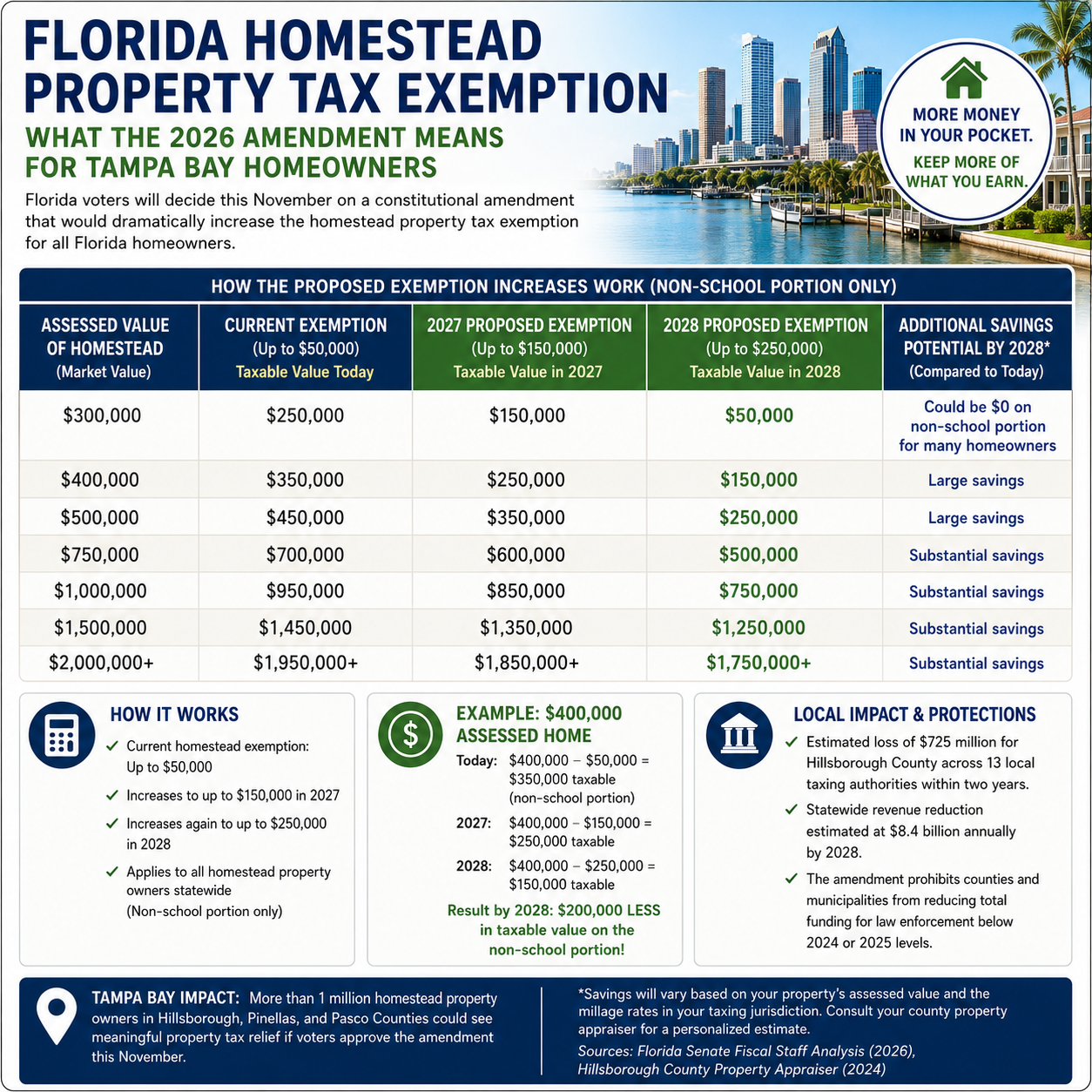
For a homeowner with an assessed value of $400,000 and the current $50,000 homestead exemption, their taxable value for non-school purposes is $350,000. Under the proposed $250,000 exemption, that taxable value drops to $150,000, meaning a significant reduction in the non-school portion of the tax bill. By 2028, a $300,000 assessed home with full homestead could potentially owe nothing on the non-school portion at all. The actual savings depend on your property’s assessed value and the millage rates in your specific taxing jurisdiction, so each homeowner should run the numbers with their county property appraiser’s office for an accurate picture.
Local governments are already working through the fiscal impact. Hillsborough County’s property appraiser estimates a combined loss of $725 million across 13 local taxing authorities within two years. Statewide, the Senate analysis puts the annual revenue reduction at approximately $8.4 billion by 2028. The amendment includes a provision prohibiting counties and municipalities from reducing total funding for law enforcement below 2024 or 2025 levels, which addresses one of the central concerns raised by critics. What happens to other local services, infrastructure, and capital projects under a reduced tax base is still a subject of ongoing debate and is worth watching closely.
If you are thinking about what this could mean for your home’s value or your next move, a [market analysis](/market-analysis/) of your specific neighborhood can help you understand where things stand today and how shifting tax dynamics may factor into buyer demand going forward.
Buyers, Sellers, and Investors: What This Means for You
The December 31, 2026 Deadline Is Real
One of the most consequential details buried in the amendment language is a residency requirement for new Floridians. Anyone who establishes primary Florida residency after December 31, 2026, must maintain that residency for up to five years before qualifying for the full increased homestead exemption. If you are relocating from California, New York, or anywhere else and you close on a home and establish homestead residency by December 31, 2026, you would step into the expanded exemption when it takes effect in 2027. Wait until 2027 to move and you may be waiting years for the full benefit.
This is exactly why our phones are ringing now. Savvy buyers from out of state are beginning their search months before they have full liquidity, because the calendar matters as much as the purchase price. If you are considering a move to St. Petersburg, Clearwater, or anywhere in the Tampa Bay area, connecting early with a local [buyer’s agent](/buyers-agent/) who understands these timelines can make a meaningful difference in how this plays out for you financially.
Lower Taxes Tend to Support Higher Values
For homeowners considering a sale, the amendment introduces an interesting dynamic. When the ongoing cost of ownership decreases significantly, buyers can often justify paying more for the same home. Property tax savings of thousands of dollars per year are real money, and buyers do factor that into affordability calculations, particularly buyers relocating from high-tax states where property taxes on a comparable home might cost two or three times as much annually.
It is too early to say with certainty how much the amendment would move values, and market conditions depend on many factors beyond tax policy. But the directional logic is straightforward: reduced carrying costs tend to support demand, and sustained demand tends to support prices. If you are thinking about selling in the next one to two years, getting a current [home valuation](/home-valuation/) now gives you a baseline and helps you time your listing with local market conditions.
The Non-Homestead Cap Change Also Matters
The amendment is not only about homesteaded primary residences. The reduction in the annual assessment cap for non-homestead properties from 10% to 5% starting in 2027 is significant for investors, landlords, and anyone holding rental or investment property in Tampa Bay. Under the current 10% cap, assessed values on non-homestead properties can climb quickly in a rising market. A 5% cap provides more predictability and limits runaway tax increases on portfolios.
Keep in mind that investment properties do not qualify for the homestead exemption at all, so the expanded exemption itself would not benefit a rental home or a short-term rental. The cap reduction is the relevant provision for non-homestead investors. As always, verify what applies to each specific property with a qualified tax professional, since assessed values, millage rates, and exemption eligibility can vary by address and ownership structure.
What to Verify Before You Make Any Decisions
This amendment involves your money, your taxes, and in some cases your timing on one of the largest financial decisions of your life. Here is what to confirm before acting on anything you read, including this article.
1. Verify whether the amendment passed. The November 3, 2026 vote has not yet happened as of this writing. Everything here is based on what is on the ballot, not what is law. Check the Florida Division of Elections website or your county supervisor of elections for official results after Election Day.
2. Confirm your homestead eligibility. The homestead exemption requires that the home be your primary Florida residence. You must apply for homestead exemption with your county property appraiser’s office, typically by March 1 of the tax year. Homestead is not automatic and is not transferable from a previous owner.
3. Understand the residency deadline for newcomers. If the amendment passes and you are relocating from out of state, speak with a qualified tax professional about what establishing Florida residency by December 31, 2026 actually requires, including driver’s license, voter registration, and domicile documentation.
4. Do not assume your specific tax bill. Every property has a different assessed value, and each taxing jurisdiction applies different millage rates. Contact the Pinellas County, Hillsborough County, or Pasco County property appraiser’s office directly to understand what the proposed exemption would mean for your specific address.
5. Watch for implementing legislation. The amendment as passed directs the Legislature to develop a schedule for phasing out remaining non-school property taxes beyond 2028. The details of that schedule have not been written yet, and future legislative sessions will determine how the full elimination pathway unfolds.
This Is a Pivotal Moment for Tampa Bay Real Estate
Florida has long offered structural advantages that attract residents from high-tax states: no state income tax, a warm climate, and a quality of life that is hard to replicate at this price point. The proposed property tax amendment, if voters approve it in November, would add another layer to that equation and make the value proposition of owning a primary home here even more compelling.
What makes the west coast of Florida particularly interesting right now is that the conversation about affordability still applies here in a way it does not in Miami or Palm Beach. St. Petersburg, Clearwater, Sarasota, and the broader Tampa Bay area offer waterfront access, walkable neighborhoods, and genuine community character at a fraction of the price per square foot of Florida’s southeast coast. That gap tends to close over time as more buyers discover it.
Whether you are a longtime local homeowner trying to understand what November’s vote means for your tax bill, a buyer timing a relocation from out of state, or an investor assessing how the non-homestead cap change affects your portfolio, this is not a decision to make in isolation. A [real estate consultation](/real-estate-consultation/) can help you think through the timing, the numbers, and the local market dynamics that apply specifically to your situation. Liane works with buyers and sellers across Pinellas and Hillsborough counties and brings the kind of local context that makes a meaningful difference when the stakes are this high.
FAQ: Florida's 2026 Property Tax Amendment
The amendment, known as HJR 1F or “Save Our Homes from Excessive Property Taxes,” is a proposed change to the Florida Constitution that would increase the homestead exemption on non-school property taxes to $150,000 in 2027 and $250,000 in 2028. It was passed by the Florida Legislature in June 2026 and will appear on the November 3, 2026 statewide ballot, where it requires 60% voter approval to take effect.
No. The amendment applies only to non-school ad valorem taxes. School board property taxes would remain in place and are not affected by the exemption increase. The Legislature is directed to develop a future schedule for phasing out remaining non-school taxes over time, but the full timeline and details of that phase-out have not yet been established.
If you are relocating from another state and plan to claim Florida homestead, the amendment includes a provision that requires new Florida residents to maintain primary residency for up to five years before qualifying for the full expanded exemption, if they establish residency after December 31, 2026. Establishing primary Florida residency by that date may allow you to qualify for the expanded exemption when it takes effect in 2027. You should verify your specific situation with a qualified tax professional and your county property appraiser’s office, as the requirements involve multiple factors including driver’s license, voter registration, and domicile documentation.
Investment properties and rental homes do not qualify for the homestead exemption, so the increased exemption itself would not apply to non-primary residences. However, the amendment also lowers the annual assessment cap on non-homestead properties from 10% to 5% beginning January 1, 2027. This is the most relevant provision for investors, as it would limit how quickly assessed values can rise on rental homes, vacation properties, and commercial real estate from year to year.
The best first step is to talk to a local real estate professional who understands both the current market and the potential implications of the November vote. For buyers considering a relocation, the timing of your move and homestead establishment could have meaningful financial consequences. For sellers, understanding how buyer demand may shift as this amendment gets more attention is valuable context for pricing and timing a listing. Liane offers a free consultation and can walk you through what the current market looks like in your target area.

Have Questions About How the Property Tax Amendment Affects Your Move?
Florida’s property tax landscape may be on the verge of a significant change, and whether you are buying, selling, or simply trying to understand what it means for your home’s value, local expertise matters. Liane works with homeowners, buyers, and investors across St. Petersburg, Clearwater, and the greater Tampa Bay area. Reach out to schedule a free consultation and get straightforward answers tailored to your specific situation.
Schedule Your Free Consultation




Leave a Reply